


The Tommy Project
The Poor
It’s the anarchy of poverty
delights me, the old
yellow wooden house indented
among the new brick tenements
Or a cast-iron balcony
with panels showing oak branches
in full leaf. It fits
the dress of children
reflecting every stage and
custom of necessity—
Chimneys, roofs, fences of
wood and metal in an unfenced
age and enclosing next to
nothing at all: the old man
in a sweater and soft black
hat who sweeps the sidewalk
his own ten feet of it
in a wind that fitfully
turning his corner has
overwhelmed the entire city
William Carlos Williams (1938)
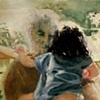
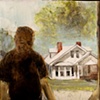
In the summer of 2007, I made a careful and conscious choice to build my house, including my art studio, in East Lake, a not so trendy “yet-to-be-revitalized” Chattanooga neighborhood that I intended would become the future focus of my art. My first major step in this direction includes these two and currently untitled works of “Tommy,” the focal point of my ongoing MakeWork grant project, funded by CreateHere.
“Tommy” is a mentally-handicapped man in his fifties who lives with his wife and family in a house just down the street from my own. In this project, I am investigating the paradoxes that define Tommy’s existence as a fixture in his Chattanooga neighborhood who seems entirely at home and familiar with every person and object on his street, but who will yet always remain to some extent lost in his own world, due to his poverty and his intellectual limitations. As I paint, I strive to escape condescension by remaining cognizant of the fact that to some indeterminate extent, we are all lost in our own neighborhoods, due to the intellectual and social pressures that define our subjectivities.
These painting are the first in a series to articulate my social and cultural interests of a larger vision of one, inner-city neighborhood to its dynamic, and in many ways thriving, city.
On the occasions when I notice Tommy outside or when he rings my doorbell, I try to make myself available for our short conversations. If he isn’t coming to ask to mow my lawn, to rake my leaves, or to borrow five dollars so that he and Nora can take a bus to see a doctor, he usually reports to me about the current state of affairs in his home in terms of whom he has had to kick out. The pattern seems to be that one of the daughters or granddaughters and her boyfriend will move back in with Tommy and Nora. This lasts for about a month until someone hits Nora or a great grandchild. Tommy then tells me with a raised fist and a stutter, “I told him to hit the road and don’t come back.” Tommy- style, he inevitably punctuates his brief account of the argument with the question, “Do you blame me?” To which I reply “No that’s bad, I don’t blame you.” Without a goodbye he turns away and walks on up the street. Although our conversations are short and mostly repetitive, Tommy and I have grown attached to each other in a harsh neighborhood where folks don’t usually smile and where guttural sounding curse words are easily heard instructing small children to stay out of the road.
It’s the anarchy of poverty
delights me, the old
yellow wooden house indented
among the new brick tenements
Or a cast-iron balcony
with panels showing oak branches
in full leaf. It fits
the dress of children
reflecting every stage and
custom of necessity—
Chimneys, roofs, fences of
wood and metal in an unfenced
age and enclosing next to
nothing at all: the old man
in a sweater and soft black
hat who sweeps the sidewalk
his own ten feet of it
in a wind that fitfully
turning his corner has
overwhelmed the entire city
William Carlos Williams (1938)
In the summer of 2007, I made a careful and conscious choice to build my house, including my art studio, in East Lake, a not so trendy “yet-to-be-revitalized” Chattanooga neighborhood that I intended would become the future focus of my art. My first major step in this direction includes these two and currently untitled works of “Tommy,” the focal point of my ongoing MakeWork grant project, funded by CreateHere.
“Tommy” is a mentally-handicapped man in his fifties who lives with his wife and family in a house just down the street from my own. In this project, I am investigating the paradoxes that define Tommy’s existence as a fixture in his Chattanooga neighborhood who seems entirely at home and familiar with every person and object on his street, but who will yet always remain to some extent lost in his own world, due to his poverty and his intellectual limitations. As I paint, I strive to escape condescension by remaining cognizant of the fact that to some indeterminate extent, we are all lost in our own neighborhoods, due to the intellectual and social pressures that define our subjectivities.
These painting are the first in a series to articulate my social and cultural interests of a larger vision of one, inner-city neighborhood to its dynamic, and in many ways thriving, city.
On the occasions when I notice Tommy outside or when he rings my doorbell, I try to make myself available for our short conversations. If he isn’t coming to ask to mow my lawn, to rake my leaves, or to borrow five dollars so that he and Nora can take a bus to see a doctor, he usually reports to me about the current state of affairs in his home in terms of whom he has had to kick out. The pattern seems to be that one of the daughters or granddaughters and her boyfriend will move back in with Tommy and Nora. This lasts for about a month until someone hits Nora or a great grandchild. Tommy then tells me with a raised fist and a stutter, “I told him to hit the road and don’t come back.” Tommy- style, he inevitably punctuates his brief account of the argument with the question, “Do you blame me?” To which I reply “No that’s bad, I don’t blame you.” Without a goodbye he turns away and walks on up the street. Although our conversations are short and mostly repetitive, Tommy and I have grown attached to each other in a harsh neighborhood where folks don’t usually smile and where guttural sounding curse words are easily heard instructing small children to stay out of the road.

